
Minor scales with sharps parallel movement
Scales prove to be an integral and indispensable element of studying music, especially learning to play the piano. Practising scales is not only an important factor for developing agility, but it also helps you to get a profound theoretical background, useful in understanding the structure of music pieces.
It is important to learn and practise the scales from the earliest years of studies so as to achieve a satisfactory level of technical skill. This will provide you with one of the fundamental techniques, useful in the execution of many compositions at different levels of study.
For the preparatory exercises of the scales you can refer to the lessons "Learning scales" and "thumb passage".
Regarding the organization of the alterations see chapter titled “4 Learning scales”
LA MINORE
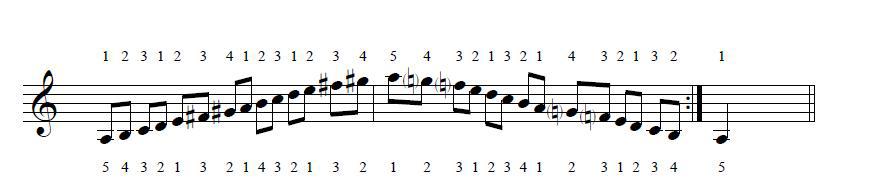
Scala la minore mano destra in Braille
Scala la minore mano sinistra in Braille
MI MINORE

Scala mi minore mano destra in Braille
Scala mi minore mano sinistra in Braille
SI MINORE
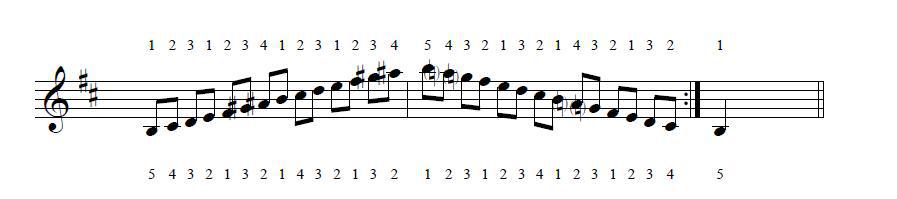
Scala si minore mano destra in Braille
Scala si minore mano sinistra in Braille
FAs MINORE

Scala fa diesis minore mano destra in Braille
Scala fa diesis minore mano sinistra in Braille
DOs MINORE

Scala do diesis minore mano destra in Braille
Scala do diesis minore mano sinistra in Braille
SOL DIESIS MINORE

Scala sol diesis minore mano destra in Braille
Scala sol diesis minore mano sinistra in Braille
RE DIESIS MINORE

Scala re diesis minore mano destra in Braille
Scala re diesis minore mano sinistra in Braille
LA DIESIS MINORE

Scala la diesis minore mano destra in Braille
Scala la diesis minore mano sinistra in Braille